


When people ask what I do, the honest answer has changed many times. I studied Systems Engineering at Universidad de San Buenaventura, and my first professional years were spent close to the people who actually use technology. Eighteen years later I work with cloud platforms, production software and AI agents, but the starting point still shapes every decision I make.
Learning at the front line
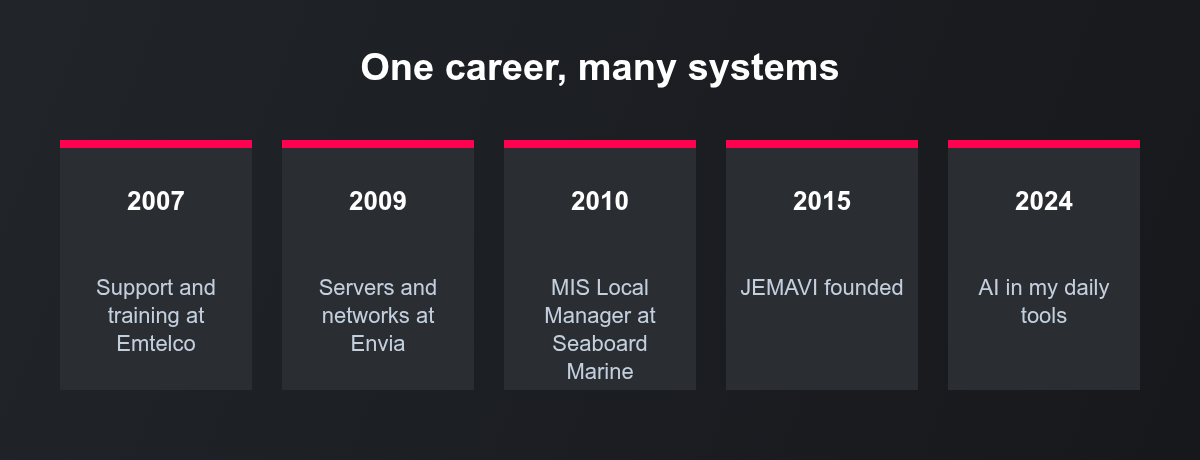
At Emtelco I supported and trained staff in an international call center, including bilingual assistance. It was a direct lesson: technology that people cannot use does not work, no matter what the diagram says. At Bancolombia I then joined a domain and building migration, supporting more than 3,000 users in Medellin and helping improve the procedures used by Level I technical staff. Scale changes everything. A small mistake repeated three thousand times stops being small.
Owning the infrastructure
At Envia Colvanes the work moved closer to the systems themselves: a corporate Windows server, a SQL Server database, a local network of 28 computers, antivirus administration and wireless IP telephony. Being responsible for a whole environment teaches something a ticket queue cannot: every part depends on another part, and you are the one who gets the call.
Then came almost five years at Seaboard Marine as MIS Local Manager. I supported local and remote users, ran the DST project in Colombia around JD Edwards inventory applications, managed SharePoint through its migration from 2003 to 2010, and kept wireless links and handheld devices running. Working in a port environment also pushed me toward logistics, and I later specialized in International Trade Logistics.
Going independent
In February 2015 I started JEMAVI. The first years were about client websites, networks and servers, followed by Ubiquiti and Cisco training. Then the work widened: VoIP deployments with Issabel and Asterisk, WordPress sites connected to ERP and POS systems, security with Wazuh, and backup scripts that had to work on the worst day of a client’s year. From 2019 onward, cloud migrations with AWS Activate became a regular part of what I do.
From running systems to building them
In recent years I have moved further into building software: production web applications with Python and FastAPI, platforms on AWS Amplify, and infrastructure defined as code. Since 2024, AI has moved from something I read about into something I use every day, and today I work with coding agents and multi-agent systems as part of normal engineering.
What has stayed the same
The tools in this story have almost nothing in common. Windows 2003 and an AI agent do not share much. What has lasted is a way of working: understand the system before touching it, assume it will fail, keep a way back, and stay responsible for the result. I learned that at a help desk, and I still use it now.